This is a quote from the blog I wrote on January 23rd:
"First of all I just want to say that this the first time in my life I've been actually surprised in a good way about a sitting president. I was worried that Obama would be all talk, but instead he dove right in from day one. He set in motion progress on the Israeli-Palestinian crisis, ended extraordinary rendition, ended Bush's spending freeze on overseas family planning, stopped legally sanctioned torture, and stated that Gitmo must be closed within a year."
It WAS too good to be true!
HOW YOU GUYS LIKE NEW OBAMA?!?!?
Remember how Obama signed that executive order 2 days in to office holding up his campaign promise?
Do you remember the eloquent language with which he simultaneously brought justice to those in need of it in the form of Habeus Corpus, as well as invoked a stern didactic tone concerning the constitution?
Well thats not Obama.
Thats OLD Obama. There is a new Obama in office, I’m not going to post a link you should all keep up with the news if you’re not a fool. Apparently a trial is too good for certain prisoners. Have you also heard that extraordinary rendition is essentially going on under a different guise? If we are able to store our prisoners overseas we can be assured they are doing so for one or both of the following reasons:
1. protect themselves from legal prosecution
2. to engage in torture
Although the federal government is still engaging in holding prisoners overseas, that is apparently ALSO too damn good for certain people currently locked up in Gitmo.
So lets get down to the info. There are apparently THIRTEEN individuals currently in gitmo who can’t POSSIBLY EVER BE TRIED IN A COURT!!!! Our courts are too weak for terrorism, they don’t have the stomachs!! and the ladies?!??!! and the children?!? how can we protect them from the blasphemy and coarse language of the terrorists????? Obviously the only answer is secret military tribunals. But we’re marketing a fuzzier name, and we're gonna market it with a little more effort than we did for “tribunal”. From here on out these secret military tributnals are “Commissions”. Did you know that the EU has a council of “Commissioners” they make up the most intense concentration of power vested in single individuals in the entire EU system? I mean whats wrong with a little commission? Its like we're all salespeople now, we all get a piece of the commission. Baseball for example is run by a commissioner and thats america's god damn pasttime! There was a show “the comish” or something right? or a movie? Whatevever it was, it was good wholesome fun for the whole family! I mean this secret kangaroo court is like a household name already, so back to american gladiators!
But of these 13 (whom I cannot find all the names of btw), 4 of them are charged with THE CRIMES OF related to THE ATTACKS OF THE TERRORISTS OF FOREIGN LANDS UPON THE HOMELAND UNITED STATES OF AMERICA NEW YORK ON THE DATE OF NINE ELEVEN IN AN EGREGIOUS ACT OF COWARDICE. So seriously, don’t question it.But wait a second, they're not "charged" with anything...they are "involved" or "connected to" (or something along those lines) to NINE ELEVEN in the articles of the mainstream media. Well I'm not a doctor or anything, but if they're so wholly convinced that this individual is complicit with 9/11 shouldn't they have been tried and either acquitted or sentenced by now? Why won't we try to bring some justice to the perpetrators of 9/11? And by that I don't mean lock someone up without a fucking trial! That is an injustice, we cannot move forward if we are constantly reacting to injustice with further injustices. These people that are connected to 9/11 how are they connected? All we have been told is that they knew bin laden or are in al qaeda or some shit. If people are so secure in these individuals' guilt that they imprison them, shouldn't their evidence be good enough to convict the individual?
Of course not. And we all know that no matter where you fall on the political spectrum we all know that if cops, military, or intelligence agencies were allowed to just imprison people they thought were guilty, it would VERY OFTEN be an individual who would not be convicted by a jury of their peers.
But the praises continue to be sung, the veneer of unity and the brand name of being different than bush are still holding up.
The truth is that very little has changed in the substantive issues, and by that I mean issues relating to the constitution, geneva conventions, and military aggression. Maybe the torture won't continue on american soil...wait...bush never even tortured people on american soil(at least not the continental US[gitmo]). So......I ask everyone: what changed?
A sane tax system is good, credit card legislation, etc. but these have very little to do with moving away from the dangerous policies of bush.
The change offered by Obama is superficial at best.
And Obama I had kept my hope low, but you didn’t even live up TO YOUR OWN hope. so fuck you
And What the fuck is the deal with cheney? He actually has influence on Obama, apparently a SHIT TON! Just put cheney on fox news a few hours a day complaining about terrorists being about to attack trying to scare americans and all of a sudden obama doesn’t care about torture, extraordinary rendition, or even habeus corpus, we have not seen an improvement over Bush in the stubstantive issues.
Wait obama scared of cheney’s dire prognostications of terrorism…hmm….I wonder if there is a reason for Obama to be so scared….what do you guys think Cheney is capable of? ;)
Is it truly a radical concept for people to be charged with a crime and given a trial if they are to be imprisoned but are not prisoners of war?
Showing posts with label law. Show all posts
Showing posts with label law. Show all posts
Sunday, May 24, 2009

Friday, January 23, 2009
Just charge them with a crime, or do not
First of all I just want to say that this the first time in my life I've been actually surprised in a good way about a sitting president. I was worried that Obama would be all talk, but instead he dove right in from day one. He set in motion progress on the Israeli-Palestinian crisis, ended extraordinary rendition, ended Bush's spending freeze on overseas family planning, stopped legally sanctioned torture, and stated that Gitmo must be closed within a year.
The last thing is what I wanted to write a few paragraphs about. Most importantly why the fuck is it that we are just NOW having this debate? When we are finally going to start bandaging this wound, thats when all of a sudden the press makes the public aware of the details.
Here is a quick summary:
-Gitmo stands on a territory that the US never gave back to Cuba after driving the Spanish out in the very late 1800s. They pay a pittance in lease, which is why there can be a US military facility in a country that the US has an embargo on.
-Gitmo was chosen as the camp for captured "enemy combatants"
-Gitmo was chosen because it lay outside of any state, commonwealth, or province of the United sates. This meant that it could be argued that civilian law or even federal courts were outside their jurisdiction to regulate it. (Obviously this is fail, the federal government has jurisdiction over all military bases and BIA reservations, etc. basically everything in between)
-There is no such thing as an "enemy combatant", it is nowhere in the Geneva conventions. It was created so that the captured individuals would not be "prisoners of war" and thusly be protected under the Geneva conventions(that treaty everyone signed to prevent Naziesque atrocities from being committed in the future).
-Can't remember which legal stooge came up with this bullshit (my guess is either gonzalez, thurmond's scion, or the taft scion) but they wanted to ensure they wouldn't be prosecuted for the warcrimes they were going to commit. If these attorneys had come in to a possession of a pair of testicles at any point they could have written the exact opposite and these chickenhawks probably would have never tortured in the first place for fear of punishment. That of course assumes they weren't just told what their legal justification should say. The point is they argue that because Afghanistan is a "failed state" that makes the people captured "enemy combatants" rather than "prisoners of war". Precedent? Fuck precedent!
-A brand new secret military tribunal process was set up to try "enemy combatants" just for the war on terror.
So now that Gitmo is going to be shut down, all of a sudden the media finds it journalism to write about what Gitmo was in the first fucking place. So now the debate is: Where will they go?
The first suggestion comes from Christopher Bond(R-Missouri) to reopen Alcatraz. Ok...so I guess the Republicans aren't still salty about their loss(sarcasm). Ok so apparently the Republicans think that incarceration in a maximum security federal prison is a terrible idea, because the prisons will become magnets for attacks! Firstly it gave me pause that any Republicans would have have concern for the lives of a prisoner. Like there would be planes flying in to supermaxs all over the country. I realized that they could be arguing it would put the guards lives at risk, which I suppose is understandable. The argument though is ridiculous, prisons are made to hold criminals, they act like this is the first time prisons have been used to house criminals. Mcveigh, Unabomber, Moussaoui, Abdel-rahman(the blind sheikh), etc are all in the ADX Florence and they haven't gone through a terrorist attack or a terrorist break out.
How about if you fucking idiots stop making shit up and creating new laws for this and that, new exceptions to why we can't possibly live like we used to, and how the post 9/11 world will destroy us all?
Have a Federal prosecutor's office evaluate the cases and decide whether or not to charge these individuals with crimes. If they have committed a crime then have a trial.
OR
Establish that they are in fact prisoners of war, and go through the maritime/military law.
Where will they go?? They're not fucking superheroes we don't need to build an Arkham Asylum here or a fucking "negative zone", just put them in a cell. Like abdel-rahman already is in a fucking cell, just like binalshibh is already in a fucking cell, and just like every other CRIMINAL that has been convicted is in a cell.
I hope Obama keeps going. This is the kind of shit that Clinton would never do for fear of being labeled liberal. Obama knows what he wants, and how to get it, I just hope that what he wants is what he has been talking about. Most importantly we need an exit strategy immediately. I hate presidents, but honestly I have to say this was good shit the past few days.
The last thing is what I wanted to write a few paragraphs about. Most importantly why the fuck is it that we are just NOW having this debate? When we are finally going to start bandaging this wound, thats when all of a sudden the press makes the public aware of the details.
Here is a quick summary:
-Gitmo stands on a territory that the US never gave back to Cuba after driving the Spanish out in the very late 1800s. They pay a pittance in lease, which is why there can be a US military facility in a country that the US has an embargo on.
-Gitmo was chosen as the camp for captured "enemy combatants"
-Gitmo was chosen because it lay outside of any state, commonwealth, or province of the United sates. This meant that it could be argued that civilian law or even federal courts were outside their jurisdiction to regulate it. (Obviously this is fail, the federal government has jurisdiction over all military bases and BIA reservations, etc. basically everything in between)
-There is no such thing as an "enemy combatant", it is nowhere in the Geneva conventions. It was created so that the captured individuals would not be "prisoners of war" and thusly be protected under the Geneva conventions(that treaty everyone signed to prevent Naziesque atrocities from being committed in the future).
-Can't remember which legal stooge came up with this bullshit (my guess is either gonzalez, thurmond's scion, or the taft scion) but they wanted to ensure they wouldn't be prosecuted for the warcrimes they were going to commit. If these attorneys had come in to a possession of a pair of testicles at any point they could have written the exact opposite and these chickenhawks probably would have never tortured in the first place for fear of punishment. That of course assumes they weren't just told what their legal justification should say. The point is they argue that because Afghanistan is a "failed state" that makes the people captured "enemy combatants" rather than "prisoners of war". Precedent? Fuck precedent!
-A brand new secret military tribunal process was set up to try "enemy combatants" just for the war on terror.
So now that Gitmo is going to be shut down, all of a sudden the media finds it journalism to write about what Gitmo was in the first fucking place. So now the debate is: Where will they go?
The first suggestion comes from Christopher Bond(R-Missouri) to reopen Alcatraz. Ok...so I guess the Republicans aren't still salty about their loss(sarcasm). Ok so apparently the Republicans think that incarceration in a maximum security federal prison is a terrible idea, because the prisons will become magnets for attacks! Firstly it gave me pause that any Republicans would have have concern for the lives of a prisoner. Like there would be planes flying in to supermaxs all over the country. I realized that they could be arguing it would put the guards lives at risk, which I suppose is understandable. The argument though is ridiculous, prisons are made to hold criminals, they act like this is the first time prisons have been used to house criminals. Mcveigh, Unabomber, Moussaoui, Abdel-rahman(the blind sheikh), etc are all in the ADX Florence and they haven't gone through a terrorist attack or a terrorist break out.
How about if you fucking idiots stop making shit up and creating new laws for this and that, new exceptions to why we can't possibly live like we used to, and how the post 9/11 world will destroy us all?
Have a Federal prosecutor's office evaluate the cases and decide whether or not to charge these individuals with crimes. If they have committed a crime then have a trial.
OR
Establish that they are in fact prisoners of war, and go through the maritime/military law.
Where will they go?? They're not fucking superheroes we don't need to build an Arkham Asylum here or a fucking "negative zone", just put them in a cell. Like abdel-rahman already is in a fucking cell, just like binalshibh is already in a fucking cell, and just like every other CRIMINAL that has been convicted is in a cell.
I hope Obama keeps going. This is the kind of shit that Clinton would never do for fear of being labeled liberal. Obama knows what he wants, and how to get it, I just hope that what he wants is what he has been talking about. Most importantly we need an exit strategy immediately. I hate presidents, but honestly I have to say this was good shit the past few days.
Tuesday, December 05, 2006
Actual Successful US terror prosecutions since 9/11(Mostly notes)
These are all notes and comments culled from a different website I liked commenting on. What I was struck with in all this research was the charges that these individuals were actually brought to court and convicted on. Very few were given serious sentences, very few were charged with violent crimes, and in a few instances prosecutions were halted because of intelligence community secrecy(refusal to share info with prosecutors). It is my opinion that terrorism is a legal problem, not a military problem. Our current attempts to solve this legal problem militarily have led to an endless occupation of Iraq and an endless counter-insurgency in Afghanistan. Which will eventually cause some sort of economic or military overstrech.
Zacarias Moussaoui – Convicted of conspiring to kill Americans as part of the September 11th terrorist attacks. The decision itself seems (in my opinion) to expand what conspiracy law traditionally covers, convicted him of conspiracy simply because he possessed foreknowledge and did not warn people. When traditional conspiracy law has required a “substantial” or “significant” step towards committing the planned crime. Currently serving a life sentence at the Administrative maximum security prison facility in Florence, Colorado.
nada
R2154583 months ago
In the twelve months immediately after 9/11, the prosecution of individuals the government classified as international terrorists surged sharply higher than in the previous year. But timely data show that five years later, in the latest available period, the total number of these prosecutions has returned to roughly what they were just before the attacks. Given the widely accepted belief that the threat of terrorism in all parts of the world is much larger today than it was six or seven years ago, the extent of the recent decline in prosecutions is unexpected.
Federal prosecutors by law and custom are authorized to decline cases that are brought to them for prosecution by the investigative agencies. And over the years the prosecutors have used this power to weed out matters that for one reason or another they felt should be dropped. For international terrorism the declination rate has been high, especially in recent years. In fact, timely data show that in the first eight months of FY 2006 the assistant U.S. Attorneys rejected slightly more than nine out of ten of the referrals. Given the assumption that the investigation of international terrorism must be the single most important target area for the FBI and other agencies, the turn-down rate is hard to understand.
The typical sentences recently imposed on individuals considered to be international terrorists are not impressive. For all those convicted as a result of cases initiated in the two years after 9/11, for example, the median sentence—half got more and half got less—was 28 days. For those referrals that came in more recently—through May 31, 2006—the median sentence was 20 days. For cases started in the two year period before the 9/11 attack, the typical sentence was much longer, 41 months.
From what is now known, it appears that well-placed undercover agents and extensive electronic surveillance can largely be credited with the recent apprehension in England of scores of suspects who authorities say were planning to blow up as many as ten airliners on their way to the United States.
These same investigative tools also appear to have been important in uncovering evidence indicating that a Pakistani charity may have been diverting funds originally contributed for earthquake relief to finance the planned terrorism attacks on the jumbo jets. In the United States, as well as England, details about investigations like these leading up to the filing of formal charges are usually not revealed, only occasionally becoming known during trial or as the result of later inquiries.
Essential though the use of secret agents and secret surveillance seems to have been in these related cases, the process now moves from what necessarily is one of the most hidden activities of any government to a much more public stage: the criminal prosecution, trial and sentencing of these suspects.
In the United States, partly because of this country’s far more expansive freedom of information laws, quite complete information is available about the actual prosecution of virtually all cases, including those related to terrorism.
This report, based on detailed data obtained by TRAC under the Freedom of Information Act from the Executive Office for United States Attorneys (EOUSA), mostly focuses on the use of the nation’s criminal laws in the five years after 9/11/01 against over a thousand individuals who the government had categorized as international terrorists. See sidebar “About the Data”.
Fully acknowledging that for a variety of evidentiary reasons terrorism cases are among the most difficult challenges faced by the government, the Justice Department data about the small and declining number of prosecutions and convictions and the resulting sentences for international terrorism raise a host of questions. Among them are the following.
Despite the highly publicized incidents of actual and threatened terrorism, is it possible that the public understanding about the extent of this problem is in some ways inaccurate or exaggerated?
How effective are the government’s expanding surveillance and intelligence efforts in identifying serious terrorists?
Once the suspects have been identified, how good a job do the investigators do in obtaining evidence that will result in their conviction in court?
The question of the basic competence of the Bush Administration in managing the overall response of the United States to terrorism has in recent months become a subject of debate for candidates of both parties. And the effectiveness and fairness of criminal enforcement in this area necessarily is a significant part of the whole effort. Several months ago, on June 22, the Bush Administration itself weighed into the discussion directly when the Justice Department issued what it called a “Counterterrorism White Paper.” See About the Data for a discussion of the content of the white paper.
The Big Picture
The impact of the events of 9/11/01 on the United States is hard to exaggerate.
Within months, for example, the largest single re-organization of the federal government in more than forty years was underway as the Bush Administration and Congress began shaping the Department of Homeland Security. In the same period, the government and the airline industry agreed to a new program where federal agents would begin screening all passengers for weapons and certain kinds of explosives before they boarded their planes. And under then-secret orders from President Bush, the administration initiated or expanded new surveillance programs by the National Security Agency and the Treasury Department. Meanwhile, Congress began a long struggle to adopt a new body of law intended to profoundly alter the flow of legal and illegal migrants into the U.S. That struggle continues today.
And around the world—in London and Madrid and Indonesia and Moscow—terrorists set off powerful explosive devices. In addition to directly affecting all of the living and dying in these cities, the bombings have continued to dominate the evening news broadcasts and the morning papers and the minds of hundreds of millions of people on every continent.
Given the vast world-wide reach of the media, these developments and others have properly become an intricate part of an intense political debate in the United States and in many other countries about how best to deal with these terrifying attacks.
For the federal enforcement agencies, a very extensive effort was launched. As has been previously noted, this report focuses almost entirely on people the Justice Department thought to be international terrorists. But the government has developed a bookkeeping system to track a much broader range of activities concerning several other kinds of “terrorism” as well as what it calls “anti-terrorism.” The official Justice Department definition of who is considered an anti-terrorist is elusive. Covered by this term, according to the government manual, are those who have been targeted on the grounds that charging them with any crime might “prevent or disrupt potential or actual terrorists threats.” See Justice Department Program Categories. The counts of those tracked by the Justice Department do not include military detainees—currently numbering more than 400 individuals—who have been held in the U.S. facility in Guantanamo.
Since 9/11/01 the government has classified a very large number of individuals as either a “terrorists” or “anti-terrorists.” The bulk of them, some 6,472 individuals, were referred during the two years following the 9/11 attack. Now five years since the attack, final outcomes have been determined on three out of four of these cases.
For the total set of completions, federal prosecutors decided that nearly two out of three (64%) of them were not worth prosecuting. In addition, for 9% more of the completions, a prosecution was filed but the cases were subsequently dismissed or the individuals found not guilty. Looked at from another perspective, slightly more than one out of four of the total (27%) were convicted. Considered together, this means that five years after 9/11, looking at the 6,472 individuals in the overall count who were initially referred under the terrorist or anti-terrorist programs, only about one in five have been convicted. Details for the specific terrorism and anti-terrorism categories are shown in the adjacent table.
Despite the low success rate in obtaining convictions, the large absolute number of referrals coming from the agencies (nearly 6,500 of them) has resulted in a sizable number of convictions (1,329). For this group it is instructive to consider the penalties that were imposed:
*Only 14 (one percent) received a substantial sentence—20 years or more.
Only 67 (5 percent) received sentences of five or more years.*
Of the 1,329 who were sentenced, 704 received no prison time and an additional 327 received sentences ranging from one day to less than a year. Thus, the median or typical prison sentence for them all was zero because the majority received no time at all in prison. See Figure 4 and supporting table.
Zeroing in on International Terrorism Trends
Since shortly after 9/11/01, according to the official Justice Department definition, an international terrorist is an individual suspected of having been involved in acts that are violent or otherwise dangerous to human life which appear motivated by an intent to coerce, intimidate or retaliate against a government or civilian populations. The acts, including threats or conspiracies to engage them, also must be of an international nature and impact on the U.S.
As noted above, in the first eight months of FY 2006, Justice Department EOUSA data show that federal prosecutors filed a variety of different criminal charges against 19 individuals who they had determined met this standard. In the twelve months of the previous year, FY 2005, the Department recorded 46 such prosecutions, only a fraction of the 355 it counted in the year immediately after the attacks.
For some kinds of crime, the number of prosecutions in a given area may be a better measure of official concern about a particular problem than the actual threat. And given the deep public concerns immediately after the attacks, the very large number of international terrorism prosecutions in FY 2002 is hardly surprising. Considering the numerous warning statements from President Bush and other federal officials about the continuing nature of the terrorism threat, however, the gradual decline in these cases since the FY 2002 high point and the high rate at which prosecutors are declining to prosecute terrorism cases raises questions. See earlier table.
The Overall Portrait
Examining the year-by-year changes in government actions provides valuable insights. However, convictions in any one year may reflect investigations that originated at varying points in years past. To examine the impact of 9/11, a useful approach is to collect information about all of the referrals that originated during a set time period, and then follow these cases and examine the resulting outcomes. In this case, TRAC created what is called a “cohort” of all the referrals the Justice Department categorized as international terrorism which originated in the two years following 9/11 and traced what ultimately happened to them through the end of May 2006 (the latest available data).
The findings from TRAC’s second analysis of this cohort, now followed for almost five years, are as puzzling as those emerging from the year-by-year trends. Among them are the following:
Federal investigative agencies for the whole period referred—recommended the prosecution—of 1,391 individuals who the Justice Department classified as international terrorists.
As a result, prosecutions were filed against 335 of these individuals, about one quarter of the total.
For the whole five-year period, the assistant U.S. Attorneys also declined to prosecute 748 of the international terrorist referrals—or two out of three during this five year follow-up period. When making a decision to decline, the prosecutors are required to explain why. For more than one third of the declinations, 39% of them, the assistant U.S. Attorneys said their negative decisions were caused by a lack of evidence of criminal intent, weak or insufficient evidence or because no federal offense was evident. Also baffling was the finding that an additional 24% of the referrals were declined as a result of either an agency’s request or because of “office policy.” See adjacent table. As a result of these various decisions, the government reports that 213 individuals were convicted (by trial or plea) and 123—less than one out of ten of the original referrals—were sentenced to prison. After conviction, of course, the judges settle on the actual sentences that will be imposed. In the case of this small number of international terrorists, the sentence was one day or less than a year for 91, one year to five years for 18, five years to 20 years for eight and 20 years to life for six. Ninety received no prison sentence. (As noted above, the median or typical sentence for these 213 individuals—half got more and half got less—was 28 days.)
Lead Charge in International Terrorism Cases
Thus far in this part of the report we have been focusing on the 1,391 individuals who the assistant U.S. Attorneys in the Justice Department had classified as “international terrorists” who were referred for prosecution. Under the department’s record keeping procedures, however, a person classified as a terrorist does not have to be charged with crimes that on their face seem to involve “terrorism.” Instead, the suspect can be indicted under a wide range of different laws. And in fact, in this case, the department lists about 80 specific crimes that it said were the “lead charge” for these 1,391 accused terrorists. For five of the “international terrorists,” for example, the lead charge was 42 USC 0408, a violation of the federal old age, survivors and disability insurance law. And the lead charge for another “international terrorist” was 26 USC 7203, the willful failure to file a return. Some of the lead charges seem more fitting, but are surprising in their rarity. For only one individual judged to be an international terrorist, for example, was the lead charge 18 USC 2381 (treason). And for only two others who were so categorized during the whole five year period was the lead charge 18 USC 0871 (threat against a president and successors).
Here, at the other end of the scale, are the top five lead charges for international terrorism referrals during the post-9/11 years: 18 USC 1001 (fraud/false statements—14.5%), 18 USC 2332 (terrorism, criminal penalties—14.4%), 18 USC 2339 (providing material support to terrorists—11.6%), 18 USC 0371 (conspiracy to commit offense or to defraud US—4.7%), 18 USC 3144 (release or detention of a material witness—3.3%). In addition, lead charge information is unknown for 17.7% of cases.
The list of recorded lead charge for referrals that resulted in the defendant being convicted of some crime is shorter, but still contains a range of charges. See convictions. Heading the list was 18 USC 1001 (fraud/false statements), representing over half of all convictions—56.8%. The rest of the top 4 charges against convicted terrorists were 18 USC 1028 (fraud and related activity – ID documents—5.6%), 18 USC 1546 (fraud and misuse of visas, permits—4.7%) 18 USC 2339 (providing material support for terrorists—3.8%) and 18 USC 3144 (release or detention of material witness—3.3%). Two-thirds of all convictions for terrorism involved a fraud or fraud-related lead charge.
Agency Workload
For each referral, the Justice Department also records the agency that played the lead role in the investigation that led to it. It is not surprising that considerably more than half of the 1,391 referrals for international terrorism—913, or nearly two-thirds of them—were credited to the FBI. See Figure 6 and supporting table.
With 161 referrals, the former Immigration and Naturalization Service and later the Department of Homeland Security (DHS)—now Customs and Border Protection (CBP) along with Immigration and Customs Enforcement (ICE) immigration enforcement arms—was second. Somewhat surprisingly under the umbrella of combating international terrorists, the Social Security Administration, with 84 referrals, was third. And the 70 referrals by former Customs Service now largely CBP was the fourth most active. Fifth—with 24 referrals—was the Transportation Security Administration, now in DHS but formerly part of the Transportation Department.
But in addition to the workload, agency-by-agency outcomes for the five year period also can be examined. While the FBI led the federal government in the volume of referrals for criminal prosecution for international terrorists, federal prosecutors declined as not warranting filing charges a much higher proportion of its referrals for prosecution than referrals from most other agencies. Prosecutors filed charges on only 18 percent of FBI referrals and declined to prosecute 82 percent. More of the cases dropped by the wayside at the court stage. This means that less than one out of ten FBI cases disposed of during the five year period resulted in the defendant being convicted for any crime. The median sentence of convictions in FBI cases, although slightly higher than the overall median, was still only 6 months. See table with median prison sentences.
In contrast, it was the Social Security Administration (SSA) which racked up the highest success rate in terms of the proportion federal prosecutors decided to proceed and prosecute in court (92% prosecuted versus 8% declined), and slightly over three out of four (76%) of cases that had reached completion resulted in a conviction. Presumably, the comparatively better record of the SSA was partly related to the fact that its cases were less complex. For the 50 SSA convictions, the median sentence was one month.
The other three agencies—all now part of the Department of Homeland Security—had much less success than did the Social Security Administration when judged by either prosecution or conviction rates. Moreover, for convictions from all three DHS agencies, the median sentence was no prison time at all. This means that in over fifty percent of DHS’s convictions, the sentences were not even a single day in prison. Details for other agencies are also shown in the accompanying table.
International Terrorism Cases by Federal Judicial District
The separate offices of the United States Attorneys are vital players in the criminal enforcement of federal law. As noted above, the work of federal enforcement as a whole or within these offices can be examined in several ways. One approach is to identify all the referrals that occurred in a specific period of time and then follow the cases in the ensuing years. In this case, for example, the EOUSA data allowed the identification of every international terrorism referral recorded in each of the districts in the two years after 9/11 and the subsequent tracking of them to determine what action, if any, had been taken in regard to each as of May 2006.
The first part of this section examines international terrorism cases in this way and focuses only on the matters that were referred to the prosecutors from September 2001 to September 2003. The second section, just below, presents district-by-district counts for the full five years since 9/11 regardless of when the referral took place. This second comparison, for example, includes referrals received before 9/11/2001 but acted upon after 9/11.
When it comes to the two-year period, the top ten busiest districts are shown in Figure 7, while all districts with any activity are shown in the accompanying table.
However, one district—Eastern Virginia (Alexandria)—was by a huge margin the government’s favorite venue. In this district, located just south of the District of Columbia, the Justice Department recorded receiving somewhat more than a quarter of all referrals—297 out of the 1,322 total—that were finally classified as international terrorism.
The District of Columbia and the Southern District of New York (Manhattan) were the next two busiest districts—in terms of the number of criminal referrals—with 82 and 80 respectively. South Carolina and the Western District of New York (Buffalo) had, respectively, 65 and 63 criminal international terrorist referrals.
Many questions are raised by this distribution. The Sixth Amendment of the Constitution, for example, says that:
In all criminal prosecutions, the accused shall enjoy the right to a speedy and public trial, by an impartial jury of the State and district wherein the crime shall have been committed, which district shall have been previously ascertained by law, and to be informed of the nature and cause of the accusation; to be confronted with the witnesses against him; to have compulsory process for obtaining witnesses in his favor, and to have the Assistance of Counsel for his defence.
Critics note that the heavy concentration of international terrorism referrals in Virginia East strains the principle that defendants should be brought to trial in the district and state where their crime occurred. They also argue that prosecutors favor bringing cases here because the juries in the area near the Pentagon naturally have a large proportion of active and retired military personnel and its circuit court of appeals is among the most conservation in the United States.
The data show that Virginia East did prosecute as well as convict a much higher proportion of its criminal international terrorism referrals than was true for most other parts of the country. While nationally 31% of criminal referrals were prosecuted, in Virginia East charges were filed in court on 66%. Similarly, nationally only one in five defendants were ultimately convicted, whereas nearly half (45%) resulted in guilty pleas or verdicts in Virginia East. See district-by-district performance along with convictions by district in earlier Figure 7.
In contrast, the District of Columbia and the Southern District of New York (Manhattan)—ranked second and third in terms of the volume of referrals—turned in disappointing outcomes. D.C. had not a single conviction, and in seven out of eight of the referrals the prosecutor declined to prosecute at all. Prosecutors in Manhattan declined to prosecute 83% of the time, and less than 5 percent were ultimately convicted of any crime. And of the 3 that were convicted, two received no prison time. However, even in the much higher volume (107) convictions in Virginia East, the median prison sentence—half got less, half more—was only 1 month.For the full five-year period a somewhat different picture emerges. Because of new government withholding, it is no longer possible to obtain information on referrals since September 2003. Thus, it is not possible to examine district-by-district performance in the same way as was done earlier. Prosecution, declination, and conviction counts can be examined. In terms of these indicators of activity levels, because of the wider scope of coverage which extends to cases that began before 9/11, counts are somewhat higher. However, the same districts that were active before are active in this more encompassing list. And as before, the Eastern District of Virginia far and away leads the country. See district-by-district activity table.
Link
Post Modified: 09/15/06 16:42:29
nada
R2154593 months ago
According to the United States Attorneys reporting to the EOUSA from FY 2002 through the first eight months of 2006, the government said it had prosecuted 815 individuals who it had categorized as either “international terrorists” (579) or as being involved in “terrorist financing” (236). This total is almost twice the 441 filings claimed on page 13 of the White Paper. Link
International TerrorismFederal Criminal EnforcementOctober 1, 2001 – May 31, 2006US: Prosecutions 579, Declinations 975, Convictions 314 link
.
.
Terrorist FinancingFederal Criminal EnforcementOctober 1, 2001 – May 31, 2006
US: Prosecutions 236, Declinations 676, Convictions 149 link
Post Modified: 09/15/06 16:44:06
nada
R2154623 months ago
U.S. District Court Judge James S. Moodyunequivocally stated this view at the sentencing of Sami Amin Al-Arian on May 1, 2006:
“You were on the board of directors and an officer, the secretary. Directors control theactions of an organization, even the PIJ [Palestinian Islamic Jihad]; and you were anactive leader. When Iran, the major funding source of the PIJ, became upset becausethe PIJ could not account for how it was spending its money, it was to your board ofdirectors that it went to demand changes. Iran wanted its representative to have a sayin how its money was spent. To stop that, you leaped into action.You offered to rewrite the bylaws of the organization. You proposed that all PIJ fundsbe controlled by a three-person committee, of which you would be one of the three.You made calls to fellow directors all over the world to gather support. Thiscommittee would account for Iran’s money, all to keep the money flowing.You even pleaded for donations to pay for more such operations.[Y]ou continue to lie to your friends and supporters, claiming to abhor violence andto seek only aid for widows and orphans. Your only connection to widows andorphans is that you create them, even among the Palestinians; and you create them,not by sending your children to blow themselves out of existence. No. You exhortothers to send their children. Your children attend the finest universities this countryhas to offer while you raise money to blow up the children of others.”
.
.
For example, shortly afterSeptember 11, prosecutors focused on public allegations that the 9/11 attacks wereforeshadowed by massive aberrational investment patterns in the worldwide capital markets,a phenomenon that would have indicated advance knowledge of the plot and an effort toprofit from it. Although the prosecutors ultimately found no evidence of these systemicinvestment patterns, their efforts did uncover a securities fraud plot to take strategicinvestment advantage of law enforcement information contained in FBI files. Theinvestigation of that plot resulted in the successful prosecution of Amr Elgindy and others:• Amr Elgindy, Jeffrey Royer, Troy Peters, Jonathan Dawes, Lynn Wingate,Derrick Cleveland and Robert Hansen were charged in the Eastern District of NewYork with RICO conspiracy, insider trading, and conspiracies involving securitiesfraud and obstruction of justice, among other charges, in a case involving stockmarket manipulation and obstruction of justice which began as an investigation intowhether foreknowledge of the September 11 attacks resulted in capital marketmanipulation. Two of the defendants, Cleveland and Hansen, pled guilty and testifiedagainst Elgindy and Royer. On January 24, 2005, the jury returned a verdict,convicting Elgindy of racketeering, securities fraud and extortion, and convictingRoyer of racketeering, securities fraud, obstruction of justice and witness tampering.Wingate also pled guilty and Peters awaits trial. On June 19, 2006, Elgindy wassentenced to 108 months in prison on these charges and an additional 27 consecutivemonths on a separate indictment for false statements and committing an offense whileon release.
.
.
In the Northern District of Illinois, Enaam Arnaout, Executive Director ofBenevolence International Foundation (BIF), a purported charity, used hisorganization to illicitly obtain funds from unsuspecting people to covertly support al-Qaeda, the Chechen mujahideen, and armed violence in Bosnia. He also served as achannel for people to contribute money knowingly to such groups. The Syrian-bornnaturalized citizen has been in federal custody since he was arrested April 30, 2002,on earlier perjury charges. On February 10, 2003, Arnaout pled guilty to aracketeering conspiracy, admitting that donors of BIF were misled into believing thattheir donations would support peaceful causes when in fact funds were spent tosupport violence overseas. Arnaout also admitted to providing various items tosupport fighters in Chechnya and Bosnia-Herzegovina, including boots, tents, uniforms, and an ambulance. Arnaout was sentenced to 120 months in prison.
Other examples of terrorist financing 10 cases discussed herein which resulted inconvictions include: Al-Amoudi, Infocom, and Hammoud.
.
.
The case against Sami Al-Arian represents a particularly challenging terroristfinancing case – *one of the first cases involving extensive use of FISA intercepts andclassified information* – which ultimately resulted in conviction.• On September 21, 2004, a 53-count indictment was returned, *charging Sami AminAl-Arian and eight co-defendants with using facilities in the United States, includingthe University of South Florida, to serve as the North American base for PalestinianIslamic Jihad (PIJ)*, which was designated as a Specially Designated Terrorist (SDT)in January 1995 and a foreign terrorist organization (FTO) in 1997, and providingmaterial support to the PIJ, and conspiring to murder abroad. Additional charges formoney laundering and providing material support to an FTO were subsequentlyadded. This case relied on eight years of intercepted conversations and faxes legallyobtained pursuant to orders issued by the Foreign Intelligence Surveillance Court todemonstrate the defendants’ active involvement in PIJ’s worldwide operations.Following several months of trial which began on June 6, 2005, and lengthydeliberations, on *December 6, 2005, the jury was unable to reach a verdict on three ofthe four most serious charges against Al-Arian and Hatem Naji Fariz – RICOconspiracy, conspiracy to provide material support, and conspiracy to violate IEEPAand other various charges – and acquitted them of conspiracy to murder personsabroad and several substantive travel act, material support and money launderingcharges.* Defendants Sameeh Taha Hammoudeh and Ghassan Zayed Ballut wereacquitted of all charges.Arising from the national security investigation, Sameeh Taha Hammoudeh and hiswife, Nadia Hammoudeh, had previously been charged in a separate 15-countindictment charging tax, immigration, and mail and wire fraud offenses. On February22, 2005, both defendants pled guilty to three counts of the indictment pursuant to aplea agreement and were sentenced on June 3, 2005, to 5 years probation andrestitution of over $8,000 to the IRS. An order of removal was also entered.Hammoudeh has been removed from the United States.Hatem Naji Fariz was also charged in the Northern District of Illinois in a food stampfraud and money laundering scheme he operated in Chicago between May 1999 andDecember 2000, in connection with a grocery business he owned. Fariz defrauded theUSDA Food Stamps Program and traded cash for food stamp benefits, depositing theproceeds in his bank account. On Friday, June 16, 2006, he pled guilty to one countof wire fraud, in violation of 18 U.S.C. § 1343; and one count of money laundering,in violation of 18 U.S.C. § 1956 (a)(1)(A)(I). His sentencing is scheduled for August18, 2006. He has agreed to the forfeiture of $1,414,020.68 – the sum of the lossresulting from the fraud – to be paid in restitution to the United States.On April 14, 2006, *Sami Al-Arian pled guilty to knowingly conspiring to make orreceive contributions of funds, goods and services to the Palestinian Islamic Jihad, aspecially designated terrorist, in violation of 18 U.S.C. § 371. In his guilty plea, Al-Arian admitted that, during the period of the late 1980s and early to mid-1990s, heand several of his coconspirators were associated with the Palestinian Islamic Jihad.He further admitted that he performed various services for the PIJ in 1995* andthereafter, knowing that the PIJ had been designated as a Specially DesignatedTerrorist and that the PIJ engaged in horrific and deadly acts of violence. Suchservices included: (1) filing for immigration benefits for individuals associated withthe PIJ; (2) hiding the identities of individuals associated with the PIJ; and (3)providing assistance for an individual associated with the PIJ in a United States Courtproceeding.On May 1, 2006, *Al-Arian was sentenced to 57 months in prison, the maximumsentence under the plea agreement. He will be deported upon completion of hissentence.* At sentencing, U.S. District Judge James Moody said:
“Dr. Al-Arian, as usual, you speak very eloquently. I find it interesting thathere in public in front of everyone you praised this country, the samecountry that in private you referred to as “the great Satan”; but that’s justevidence of how you operate in the face of your friends and neighbors.You are a master manipulator. You looked your neighbors in the eyes and As part of the Intelligence Reform 11 and Terrorism Prevention Act of 2004, Congressclarified its original intent with respect to the “knowingly provides” requirement, specifying thatthe government must prove that the defendant knew that the designated foreign terroristorganization (FTO) had been designated as such or that it engages or engaged in terrorist activity.Thus it is unnecessary to establish, as the Al-Arian court held, that in providing material support,the defendant specifically sought to promote or foster the FTO’s terrorist activities.23said you had nothing to do with the Palestinian Islamic Jihad. This trialexposed that as a lie. Your back-up claim is that your efforts were only toprovide charities for widows and orphans. That, too, is a lie. Theevidence was clear in this case that *you were a leader of the PalestinianIslamic Jihad*.”
The Israeli National Police provided extraordinary assistance in the investigation andprosecution of the Al-Arian case. They arranged for FBI agents and prosecutors tointerview approximately 150 Israeli citizens in Israel, providing critical culturalliaison and translation assistance. In addition, the Israeli National Police coordinatedthe production of voluminous discovery materials, including documentationconcerning the violent attacks alleged in the indictment. During trial, Israeli NationalPolice officers escorted witnesses from Israel for testimony at trial. The IsraeliMinistry of Justice and various intelligence and military agencies also assisted U.S.investigators.As stated above, this was a complex case, and we failed to convince the jury of theweight of the evidence on the charges. *In the future, we will need to look atstreamlining such complex cases as much as possible. Because of the complexity ofthe case, the instructions to the jury to govern their deliberations were very important,and the court’s legal instructions relative to the racketeering charge were arguablyconfusing.* In addition, the government respectfully disagreed with the court’s rulingrelating to specific intent as to IEEPA and § 2339B.11 This ruling was contrary to therulings of other courts and to later, explicit Congressional enactment. We continue toexamine lessons learned from this prosecution. Ultimately, however, Al-Arian pledto a terrorism conspiracy rather than face a retrial, admitted his criminal conduct withrespect to a designated foreign terrorist organization, will serve 57 months in prison,and will be removed from the United States.
Link
Post Modified: 09/15/06 17:04:34
nada
R2154663 months ago
As a result of the severe penalties facing defendants in the criminal justice system –penalties which have been increased by the USA PATRIOT Act – defendants who plead tosuch charges often cooperate and provide intelligence to the government that can lead to thedetection of other terrorism-related activity. This not only leads to disruption of terroristrelatedactivity and further criminal prosecutions; it also provides valuable information fornational security officials so that we learn terrorists’ tradecraft and methods. Some examplesof our leveraging substantial criminal convictions and penalties to obtain cooperationinclude:14• *Abdurahman Muhammad al-Amoudi, a naturalized U.S. citizen and founder of the American Muslim Council, was stopped in England in August 2003 en route to Syriawith $340,000 in U.S. currency in his suitcase.* At the time, he claimed that the Libyan government had paid him the funds for helping to lift U.S. sanctions, and that he planned to deposit the money in a Saudi bank and bring it back to the United Statesin smaller increments to avoid detection by authorities. Al-Amoudi admittedtraveling to Libya several times over the last few years, which in itself violated U.S.law. For these trips, he used a false Yemeni passport and a visa obtained through theLibyan Embassy in Canada. In September 2003, he was arrested as he re-entered theU.S. at Dulles Airport. On July 30, 2004, Al-Amoudi pled guilty in the Eastern District of Virginia to violating sanctions on trade with Libya, naturalization fraud,and corruptly endeavoring to obstruct the IRS. As part of the plea, Al-Amoudi stipulated to his involvement in a Libyan plot to assassinate Crown Prince Abdullah of Saudi Arabia and to the applicability of the terrorism enhancement under the U.S.Sentencing Guidelines. He has been debriefed on several occasions in connectionwith a number of ongoing investigations. He has cooperated against other defendantsboth here and abroad, including providing significant assistance to the UnitedKingdom. He was sentenced on October 15, 2004, to 23 years in prison.• John Walker Lindh cooperated after pleading guilty in the Eastern District of Virginia to supporting the Taliban, in violation of the International EmergencyEconomic Powers Act (IEEPA) (50 U.S.C. § 1705(b)), and carrying an explosiveduring the commission of a felony (18 U.S.C. § 844(h)(2)), in exchange for a 20-yearprison sentence. Lindh was apprehended in Afghanistan, armed and engaged onbehalf of the Taliban. He had traveled to Pakistan and then crossed into Afghanistan,where he trained with the Taliban and took up arms on their behalf despite the factthat the United States had declared a national emergency with regard to the Talibanbased on a finding by the President that “[t]he Taliban continues to allow territoryunder its control in Afghanistan to be used as a safe haven and base of operations forUsama bin Laden and the al-Qaida organization who have committed and threaten tocontinue to commit acts of violence against the United States and its nationals.”Lindh admitted that by supplying services to and fighting in support of the Taliban, heprovided protection and sanctuary to al Qaeda, a designated foreign terroristorganization. Lindh cooperated and provided information about training camps andfighting in Afghanistan in 2001.
.
.
.
link
Post Modified: 09/15/06 17:13:11
nada
R2154723 months ago
In the two years since 9/11/01, federal investigators recommended the prosecution of more than 6,400 individuals who the government concluded had either committed terrorist acts or who were targeted on the grounds that charging them with some crime might “prevent or disrupt potential or actual terrorist threats.”
Out of those 6,400, 2,001 have become prosecutions.
Out of the 879 convicted for either committing terrorist acts or were engaged in conspiracy to commit terrorist acts only 5 have been sentenced to more than 20 years.
Out of that same 879 only 23 people convicted of terrorism were given sentences between 5 and 20 years.
In total out of the 879 successful terrorist prosecutions only 28 were sentenced to more than 5 years in prison. LINK
I can name 3 of the people who got 20 years:
John Walker Lindh, al-Amoudi, and Moussaoui.
Post Modified: 09/15/06 17:14:44
nada
R2154773 months ago
These statistics seem dubious though. Not the white paper doc, but TRAC’s data. For example:
International Terrorism Criminal Referrals by Federal Judicial District New Jersey. Referrals-16; Convictions-1;Median Prison Sentence-804 months From This
and this excerpt from a newspaper article dated 4/6/06:“Four teenagers accused of plotting to kill about 25 people in a lunch-period massacre at Winslow Township High School were charged today with terrorism, a crime no one has ever been convicted of in New Jersey.”Link
This article goes on to quote:
“State judiciary spokeswoman Winnie Comfort said no one in New Jersey has been convicted of terrorism, a charge lawmakers created four years ago in response to the Sept. 11 attacks. Under the statute, people convicted of the crime in adult court must be sentenced to at least 30 years in prison and are not eligible for parole for 30 years.”
These stats show an individual sentenced to 804 months or 67 years, yet the state judiciary spokeswoman clearly states that no one has been convicted. So it must have been a conviction that happened in the last 3 months of 2001 or the first 4 months of 2002.
These statistics are all dubious at this point. There is no distinction of exactly what the convictions and charges are for or if the heavy sentences reflect multiple counts or serious terrorism related convictions. In this Department of Justice document entitled: “Department of Justice Examples of Terrorism Convictions Since Sept. 11, 2001” Link
It states: “Hamant Lakhani (District of New Jersey) – British national Hemant Lakhani was convicted by a federal jury on charges of attempting to sell shoulder-fired missiles to what he thought was a terrorist group intent on shooting down U.S. airliners. Lakhani was sentenced to 47 years in prison.”
But this article states: “A BRITISH businessman was yesterday found guilty of attempting to provide material support to terrorists in the United States.
Hemant Lakhani, 69, from north London, was also convicted of illegal weapons brokering, two counts of money laundering and for importing merchandise into the US using false statements.
Lakhani turned to look at his wife, Kusum, in disbelief as the verdict was announced. He faces 25 years in jail.
The jury at New Jersey District Court in Newark returned its verdict after about eight hours.”
Attempting to provide material support.
Does that equate to a terrorism conviction?
This was not considered a terrorist conviction by TRAC’s statistics.
Zacarias Moussaoui – Convicted of conspiring to kill Americans as part of the September 11th terrorist attacks. The decision itself seems (in my opinion) to expand what conspiracy law traditionally covers, convicted him of conspiracy simply because he possessed foreknowledge and did not warn people. When traditional conspiracy law has required a “substantial” or “significant” step towards committing the planned crime. Currently serving a life sentence at the Administrative maximum security prison facility in Florence, Colorado.
nada
R2154583 months ago
In the twelve months immediately after 9/11, the prosecution of individuals the government classified as international terrorists surged sharply higher than in the previous year. But timely data show that five years later, in the latest available period, the total number of these prosecutions has returned to roughly what they were just before the attacks. Given the widely accepted belief that the threat of terrorism in all parts of the world is much larger today than it was six or seven years ago, the extent of the recent decline in prosecutions is unexpected.
Federal prosecutors by law and custom are authorized to decline cases that are brought to them for prosecution by the investigative agencies. And over the years the prosecutors have used this power to weed out matters that for one reason or another they felt should be dropped. For international terrorism the declination rate has been high, especially in recent years. In fact, timely data show that in the first eight months of FY 2006 the assistant U.S. Attorneys rejected slightly more than nine out of ten of the referrals. Given the assumption that the investigation of international terrorism must be the single most important target area for the FBI and other agencies, the turn-down rate is hard to understand.
The typical sentences recently imposed on individuals considered to be international terrorists are not impressive. For all those convicted as a result of cases initiated in the two years after 9/11, for example, the median sentence—half got more and half got less—was 28 days. For those referrals that came in more recently—through May 31, 2006—the median sentence was 20 days. For cases started in the two year period before the 9/11 attack, the typical sentence was much longer, 41 months.
From what is now known, it appears that well-placed undercover agents and extensive electronic surveillance can largely be credited with the recent apprehension in England of scores of suspects who authorities say were planning to blow up as many as ten airliners on their way to the United States.
These same investigative tools also appear to have been important in uncovering evidence indicating that a Pakistani charity may have been diverting funds originally contributed for earthquake relief to finance the planned terrorism attacks on the jumbo jets. In the United States, as well as England, details about investigations like these leading up to the filing of formal charges are usually not revealed, only occasionally becoming known during trial or as the result of later inquiries.
Essential though the use of secret agents and secret surveillance seems to have been in these related cases, the process now moves from what necessarily is one of the most hidden activities of any government to a much more public stage: the criminal prosecution, trial and sentencing of these suspects.
In the United States, partly because of this country’s far more expansive freedom of information laws, quite complete information is available about the actual prosecution of virtually all cases, including those related to terrorism.
This report, based on detailed data obtained by TRAC under the Freedom of Information Act from the Executive Office for United States Attorneys (EOUSA), mostly focuses on the use of the nation’s criminal laws in the five years after 9/11/01 against over a thousand individuals who the government had categorized as international terrorists. See sidebar “About the Data”.
Fully acknowledging that for a variety of evidentiary reasons terrorism cases are among the most difficult challenges faced by the government, the Justice Department data about the small and declining number of prosecutions and convictions and the resulting sentences for international terrorism raise a host of questions. Among them are the following.
Despite the highly publicized incidents of actual and threatened terrorism, is it possible that the public understanding about the extent of this problem is in some ways inaccurate or exaggerated?
How effective are the government’s expanding surveillance and intelligence efforts in identifying serious terrorists?
Once the suspects have been identified, how good a job do the investigators do in obtaining evidence that will result in their conviction in court?
The question of the basic competence of the Bush Administration in managing the overall response of the United States to terrorism has in recent months become a subject of debate for candidates of both parties. And the effectiveness and fairness of criminal enforcement in this area necessarily is a significant part of the whole effort. Several months ago, on June 22, the Bush Administration itself weighed into the discussion directly when the Justice Department issued what it called a “Counterterrorism White Paper.” See About the Data for a discussion of the content of the white paper.
The Big Picture
The impact of the events of 9/11/01 on the United States is hard to exaggerate.
Within months, for example, the largest single re-organization of the federal government in more than forty years was underway as the Bush Administration and Congress began shaping the Department of Homeland Security. In the same period, the government and the airline industry agreed to a new program where federal agents would begin screening all passengers for weapons and certain kinds of explosives before they boarded their planes. And under then-secret orders from President Bush, the administration initiated or expanded new surveillance programs by the National Security Agency and the Treasury Department. Meanwhile, Congress began a long struggle to adopt a new body of law intended to profoundly alter the flow of legal and illegal migrants into the U.S. That struggle continues today.
And around the world—in London and Madrid and Indonesia and Moscow—terrorists set off powerful explosive devices. In addition to directly affecting all of the living and dying in these cities, the bombings have continued to dominate the evening news broadcasts and the morning papers and the minds of hundreds of millions of people on every continent.
Given the vast world-wide reach of the media, these developments and others have properly become an intricate part of an intense political debate in the United States and in many other countries about how best to deal with these terrifying attacks.
For the federal enforcement agencies, a very extensive effort was launched. As has been previously noted, this report focuses almost entirely on people the Justice Department thought to be international terrorists. But the government has developed a bookkeeping system to track a much broader range of activities concerning several other kinds of “terrorism” as well as what it calls “anti-terrorism.” The official Justice Department definition of who is considered an anti-terrorist is elusive. Covered by this term, according to the government manual, are those who have been targeted on the grounds that charging them with any crime might “prevent or disrupt potential or actual terrorists threats.” See Justice Department Program Categories. The counts of those tracked by the Justice Department do not include military detainees—currently numbering more than 400 individuals—who have been held in the U.S. facility in Guantanamo.
Since 9/11/01 the government has classified a very large number of individuals as either a “terrorists” or “anti-terrorists.” The bulk of them, some 6,472 individuals, were referred during the two years following the 9/11 attack. Now five years since the attack, final outcomes have been determined on three out of four of these cases.
For the total set of completions, federal prosecutors decided that nearly two out of three (64%) of them were not worth prosecuting. In addition, for 9% more of the completions, a prosecution was filed but the cases were subsequently dismissed or the individuals found not guilty. Looked at from another perspective, slightly more than one out of four of the total (27%) were convicted. Considered together, this means that five years after 9/11, looking at the 6,472 individuals in the overall count who were initially referred under the terrorist or anti-terrorist programs, only about one in five have been convicted. Details for the specific terrorism and anti-terrorism categories are shown in the adjacent table.
Despite the low success rate in obtaining convictions, the large absolute number of referrals coming from the agencies (nearly 6,500 of them) has resulted in a sizable number of convictions (1,329). For this group it is instructive to consider the penalties that were imposed:
*Only 14 (one percent) received a substantial sentence—20 years or more.
Only 67 (5 percent) received sentences of five or more years.*
Of the 1,329 who were sentenced, 704 received no prison time and an additional 327 received sentences ranging from one day to less than a year. Thus, the median or typical prison sentence for them all was zero because the majority received no time at all in prison. See Figure 4 and supporting table.
Zeroing in on International Terrorism Trends
Since shortly after 9/11/01, according to the official Justice Department definition, an international terrorist is an individual suspected of having been involved in acts that are violent or otherwise dangerous to human life which appear motivated by an intent to coerce, intimidate or retaliate against a government or civilian populations. The acts, including threats or conspiracies to engage them, also must be of an international nature and impact on the U.S.
As noted above, in the first eight months of FY 2006, Justice Department EOUSA data show that federal prosecutors filed a variety of different criminal charges against 19 individuals who they had determined met this standard. In the twelve months of the previous year, FY 2005, the Department recorded 46 such prosecutions, only a fraction of the 355 it counted in the year immediately after the attacks.
For some kinds of crime, the number of prosecutions in a given area may be a better measure of official concern about a particular problem than the actual threat. And given the deep public concerns immediately after the attacks, the very large number of international terrorism prosecutions in FY 2002 is hardly surprising. Considering the numerous warning statements from President Bush and other federal officials about the continuing nature of the terrorism threat, however, the gradual decline in these cases since the FY 2002 high point and the high rate at which prosecutors are declining to prosecute terrorism cases raises questions. See earlier table.
The Overall Portrait
Examining the year-by-year changes in government actions provides valuable insights. However, convictions in any one year may reflect investigations that originated at varying points in years past. To examine the impact of 9/11, a useful approach is to collect information about all of the referrals that originated during a set time period, and then follow these cases and examine the resulting outcomes. In this case, TRAC created what is called a “cohort” of all the referrals the Justice Department categorized as international terrorism which originated in the two years following 9/11 and traced what ultimately happened to them through the end of May 2006 (the latest available data).
The findings from TRAC’s second analysis of this cohort, now followed for almost five years, are as puzzling as those emerging from the year-by-year trends. Among them are the following:
Federal investigative agencies for the whole period referred—recommended the prosecution—of 1,391 individuals who the Justice Department classified as international terrorists.
As a result, prosecutions were filed against 335 of these individuals, about one quarter of the total.
For the whole five-year period, the assistant U.S. Attorneys also declined to prosecute 748 of the international terrorist referrals—or two out of three during this five year follow-up period. When making a decision to decline, the prosecutors are required to explain why. For more than one third of the declinations, 39% of them, the assistant U.S. Attorneys said their negative decisions were caused by a lack of evidence of criminal intent, weak or insufficient evidence or because no federal offense was evident. Also baffling was the finding that an additional 24% of the referrals were declined as a result of either an agency’s request or because of “office policy.” See adjacent table. As a result of these various decisions, the government reports that 213 individuals were convicted (by trial or plea) and 123—less than one out of ten of the original referrals—were sentenced to prison. After conviction, of course, the judges settle on the actual sentences that will be imposed. In the case of this small number of international terrorists, the sentence was one day or less than a year for 91, one year to five years for 18, five years to 20 years for eight and 20 years to life for six. Ninety received no prison sentence. (As noted above, the median or typical sentence for these 213 individuals—half got more and half got less—was 28 days.)
Lead Charge in International Terrorism Cases
Thus far in this part of the report we have been focusing on the 1,391 individuals who the assistant U.S. Attorneys in the Justice Department had classified as “international terrorists” who were referred for prosecution. Under the department’s record keeping procedures, however, a person classified as a terrorist does not have to be charged with crimes that on their face seem to involve “terrorism.” Instead, the suspect can be indicted under a wide range of different laws. And in fact, in this case, the department lists about 80 specific crimes that it said were the “lead charge” for these 1,391 accused terrorists. For five of the “international terrorists,” for example, the lead charge was 42 USC 0408, a violation of the federal old age, survivors and disability insurance law. And the lead charge for another “international terrorist” was 26 USC 7203, the willful failure to file a return. Some of the lead charges seem more fitting, but are surprising in their rarity. For only one individual judged to be an international terrorist, for example, was the lead charge 18 USC 2381 (treason). And for only two others who were so categorized during the whole five year period was the lead charge 18 USC 0871 (threat against a president and successors).
Here, at the other end of the scale, are the top five lead charges for international terrorism referrals during the post-9/11 years: 18 USC 1001 (fraud/false statements—14.5%), 18 USC 2332 (terrorism, criminal penalties—14.4%), 18 USC 2339 (providing material support to terrorists—11.6%), 18 USC 0371 (conspiracy to commit offense or to defraud US—4.7%), 18 USC 3144 (release or detention of a material witness—3.3%). In addition, lead charge information is unknown for 17.7% of cases.
The list of recorded lead charge for referrals that resulted in the defendant being convicted of some crime is shorter, but still contains a range of charges. See convictions. Heading the list was 18 USC 1001 (fraud/false statements), representing over half of all convictions—56.8%. The rest of the top 4 charges against convicted terrorists were 18 USC 1028 (fraud and related activity – ID documents—5.6%), 18 USC 1546 (fraud and misuse of visas, permits—4.7%) 18 USC 2339 (providing material support for terrorists—3.8%) and 18 USC 3144 (release or detention of material witness—3.3%). Two-thirds of all convictions for terrorism involved a fraud or fraud-related lead charge.
Agency Workload
For each referral, the Justice Department also records the agency that played the lead role in the investigation that led to it. It is not surprising that considerably more than half of the 1,391 referrals for international terrorism—913, or nearly two-thirds of them—were credited to the FBI. See Figure 6 and supporting table.
With 161 referrals, the former Immigration and Naturalization Service and later the Department of Homeland Security (DHS)—now Customs and Border Protection (CBP) along with Immigration and Customs Enforcement (ICE) immigration enforcement arms—was second. Somewhat surprisingly under the umbrella of combating international terrorists, the Social Security Administration, with 84 referrals, was third. And the 70 referrals by former Customs Service now largely CBP was the fourth most active. Fifth—with 24 referrals—was the Transportation Security Administration, now in DHS but formerly part of the Transportation Department.
But in addition to the workload, agency-by-agency outcomes for the five year period also can be examined. While the FBI led the federal government in the volume of referrals for criminal prosecution for international terrorists, federal prosecutors declined as not warranting filing charges a much higher proportion of its referrals for prosecution than referrals from most other agencies. Prosecutors filed charges on only 18 percent of FBI referrals and declined to prosecute 82 percent. More of the cases dropped by the wayside at the court stage. This means that less than one out of ten FBI cases disposed of during the five year period resulted in the defendant being convicted for any crime. The median sentence of convictions in FBI cases, although slightly higher than the overall median, was still only 6 months. See table with median prison sentences.
In contrast, it was the Social Security Administration (SSA) which racked up the highest success rate in terms of the proportion federal prosecutors decided to proceed and prosecute in court (92% prosecuted versus 8% declined), and slightly over three out of four (76%) of cases that had reached completion resulted in a conviction. Presumably, the comparatively better record of the SSA was partly related to the fact that its cases were less complex. For the 50 SSA convictions, the median sentence was one month.
The other three agencies—all now part of the Department of Homeland Security—had much less success than did the Social Security Administration when judged by either prosecution or conviction rates. Moreover, for convictions from all three DHS agencies, the median sentence was no prison time at all. This means that in over fifty percent of DHS’s convictions, the sentences were not even a single day in prison. Details for other agencies are also shown in the accompanying table.
International Terrorism Cases by Federal Judicial District
The separate offices of the United States Attorneys are vital players in the criminal enforcement of federal law. As noted above, the work of federal enforcement as a whole or within these offices can be examined in several ways. One approach is to identify all the referrals that occurred in a specific period of time and then follow the cases in the ensuing years. In this case, for example, the EOUSA data allowed the identification of every international terrorism referral recorded in each of the districts in the two years after 9/11 and the subsequent tracking of them to determine what action, if any, had been taken in regard to each as of May 2006.
The first part of this section examines international terrorism cases in this way and focuses only on the matters that were referred to the prosecutors from September 2001 to September 2003. The second section, just below, presents district-by-district counts for the full five years since 9/11 regardless of when the referral took place. This second comparison, for example, includes referrals received before 9/11/2001 but acted upon after 9/11.
When it comes to the two-year period, the top ten busiest districts are shown in Figure 7, while all districts with any activity are shown in the accompanying table.
However, one district—Eastern Virginia (Alexandria)—was by a huge margin the government’s favorite venue. In this district, located just south of the District of Columbia, the Justice Department recorded receiving somewhat more than a quarter of all referrals—297 out of the 1,322 total—that were finally classified as international terrorism.
The District of Columbia and the Southern District of New York (Manhattan) were the next two busiest districts—in terms of the number of criminal referrals—with 82 and 80 respectively. South Carolina and the Western District of New York (Buffalo) had, respectively, 65 and 63 criminal international terrorist referrals.
Many questions are raised by this distribution. The Sixth Amendment of the Constitution, for example, says that:
In all criminal prosecutions, the accused shall enjoy the right to a speedy and public trial, by an impartial jury of the State and district wherein the crime shall have been committed, which district shall have been previously ascertained by law, and to be informed of the nature and cause of the accusation; to be confronted with the witnesses against him; to have compulsory process for obtaining witnesses in his favor, and to have the Assistance of Counsel for his defence.
Critics note that the heavy concentration of international terrorism referrals in Virginia East strains the principle that defendants should be brought to trial in the district and state where their crime occurred. They also argue that prosecutors favor bringing cases here because the juries in the area near the Pentagon naturally have a large proportion of active and retired military personnel and its circuit court of appeals is among the most conservation in the United States.
The data show that Virginia East did prosecute as well as convict a much higher proportion of its criminal international terrorism referrals than was true for most other parts of the country. While nationally 31% of criminal referrals were prosecuted, in Virginia East charges were filed in court on 66%. Similarly, nationally only one in five defendants were ultimately convicted, whereas nearly half (45%) resulted in guilty pleas or verdicts in Virginia East. See district-by-district performance along with convictions by district in earlier Figure 7.
In contrast, the District of Columbia and the Southern District of New York (Manhattan)—ranked second and third in terms of the volume of referrals—turned in disappointing outcomes. D.C. had not a single conviction, and in seven out of eight of the referrals the prosecutor declined to prosecute at all. Prosecutors in Manhattan declined to prosecute 83% of the time, and less than 5 percent were ultimately convicted of any crime. And of the 3 that were convicted, two received no prison time. However, even in the much higher volume (107) convictions in Virginia East, the median prison sentence—half got less, half more—was only 1 month.For the full five-year period a somewhat different picture emerges. Because of new government withholding, it is no longer possible to obtain information on referrals since September 2003. Thus, it is not possible to examine district-by-district performance in the same way as was done earlier. Prosecution, declination, and conviction counts can be examined. In terms of these indicators of activity levels, because of the wider scope of coverage which extends to cases that began before 9/11, counts are somewhat higher. However, the same districts that were active before are active in this more encompassing list. And as before, the Eastern District of Virginia far and away leads the country. See district-by-district activity table.
Link
Post Modified: 09/15/06 16:42:29
nada
R2154593 months ago
According to the United States Attorneys reporting to the EOUSA from FY 2002 through the first eight months of 2006, the government said it had prosecuted 815 individuals who it had categorized as either “international terrorists” (579) or as being involved in “terrorist financing” (236). This total is almost twice the 441 filings claimed on page 13 of the White Paper. Link
International TerrorismFederal Criminal EnforcementOctober 1, 2001 – May 31, 2006US: Prosecutions 579, Declinations 975, Convictions 314 link
.
.
Terrorist FinancingFederal Criminal EnforcementOctober 1, 2001 – May 31, 2006
US: Prosecutions 236, Declinations 676, Convictions 149 link
Post Modified: 09/15/06 16:44:06
nada
R2154623 months ago
U.S. District Court Judge James S. Moodyunequivocally stated this view at the sentencing of Sami Amin Al-Arian on May 1, 2006:
“You were on the board of directors and an officer, the secretary. Directors control theactions of an organization, even the PIJ [Palestinian Islamic Jihad]; and you were anactive leader. When Iran, the major funding source of the PIJ, became upset becausethe PIJ could not account for how it was spending its money, it was to your board ofdirectors that it went to demand changes. Iran wanted its representative to have a sayin how its money was spent. To stop that, you leaped into action.You offered to rewrite the bylaws of the organization. You proposed that all PIJ fundsbe controlled by a three-person committee, of which you would be one of the three.You made calls to fellow directors all over the world to gather support. Thiscommittee would account for Iran’s money, all to keep the money flowing.You even pleaded for donations to pay for more such operations.[Y]ou continue to lie to your friends and supporters, claiming to abhor violence andto seek only aid for widows and orphans. Your only connection to widows andorphans is that you create them, even among the Palestinians; and you create them,not by sending your children to blow themselves out of existence. No. You exhortothers to send their children. Your children attend the finest universities this countryhas to offer while you raise money to blow up the children of others.”
.
.
For example, shortly afterSeptember 11, prosecutors focused on public allegations that the 9/11 attacks wereforeshadowed by massive aberrational investment patterns in the worldwide capital markets,a phenomenon that would have indicated advance knowledge of the plot and an effort toprofit from it. Although the prosecutors ultimately found no evidence of these systemicinvestment patterns, their efforts did uncover a securities fraud plot to take strategicinvestment advantage of law enforcement information contained in FBI files. Theinvestigation of that plot resulted in the successful prosecution of Amr Elgindy and others:• Amr Elgindy, Jeffrey Royer, Troy Peters, Jonathan Dawes, Lynn Wingate,Derrick Cleveland and Robert Hansen were charged in the Eastern District of NewYork with RICO conspiracy, insider trading, and conspiracies involving securitiesfraud and obstruction of justice, among other charges, in a case involving stockmarket manipulation and obstruction of justice which began as an investigation intowhether foreknowledge of the September 11 attacks resulted in capital marketmanipulation. Two of the defendants, Cleveland and Hansen, pled guilty and testifiedagainst Elgindy and Royer. On January 24, 2005, the jury returned a verdict,convicting Elgindy of racketeering, securities fraud and extortion, and convictingRoyer of racketeering, securities fraud, obstruction of justice and witness tampering.Wingate also pled guilty and Peters awaits trial. On June 19, 2006, Elgindy wassentenced to 108 months in prison on these charges and an additional 27 consecutivemonths on a separate indictment for false statements and committing an offense whileon release.
.
.
In the Northern District of Illinois, Enaam Arnaout, Executive Director ofBenevolence International Foundation (BIF), a purported charity, used hisorganization to illicitly obtain funds from unsuspecting people to covertly support al-Qaeda, the Chechen mujahideen, and armed violence in Bosnia. He also served as achannel for people to contribute money knowingly to such groups. The Syrian-bornnaturalized citizen has been in federal custody since he was arrested April 30, 2002,on earlier perjury charges. On February 10, 2003, Arnaout pled guilty to aracketeering conspiracy, admitting that donors of BIF were misled into believing thattheir donations would support peaceful causes when in fact funds were spent tosupport violence overseas. Arnaout also admitted to providing various items tosupport fighters in Chechnya and Bosnia-Herzegovina, including boots, tents, uniforms, and an ambulance. Arnaout was sentenced to 120 months in prison.
Other examples of terrorist financing 10 cases discussed herein which resulted inconvictions include: Al-Amoudi, Infocom, and Hammoud.
.
.
The case against Sami Al-Arian represents a particularly challenging terroristfinancing case – *one of the first cases involving extensive use of FISA intercepts andclassified information* – which ultimately resulted in conviction.• On September 21, 2004, a 53-count indictment was returned, *charging Sami AminAl-Arian and eight co-defendants with using facilities in the United States, includingthe University of South Florida, to serve as the North American base for PalestinianIslamic Jihad (PIJ)*, which was designated as a Specially Designated Terrorist (SDT)in January 1995 and a foreign terrorist organization (FTO) in 1997, and providingmaterial support to the PIJ, and conspiring to murder abroad. Additional charges formoney laundering and providing material support to an FTO were subsequentlyadded. This case relied on eight years of intercepted conversations and faxes legallyobtained pursuant to orders issued by the Foreign Intelligence Surveillance Court todemonstrate the defendants’ active involvement in PIJ’s worldwide operations.Following several months of trial which began on June 6, 2005, and lengthydeliberations, on *December 6, 2005, the jury was unable to reach a verdict on three ofthe four most serious charges against Al-Arian and Hatem Naji Fariz – RICOconspiracy, conspiracy to provide material support, and conspiracy to violate IEEPAand other various charges – and acquitted them of conspiracy to murder personsabroad and several substantive travel act, material support and money launderingcharges.* Defendants Sameeh Taha Hammoudeh and Ghassan Zayed Ballut wereacquitted of all charges.Arising from the national security investigation, Sameeh Taha Hammoudeh and hiswife, Nadia Hammoudeh, had previously been charged in a separate 15-countindictment charging tax, immigration, and mail and wire fraud offenses. On February22, 2005, both defendants pled guilty to three counts of the indictment pursuant to aplea agreement and were sentenced on June 3, 2005, to 5 years probation andrestitution of over $8,000 to the IRS. An order of removal was also entered.Hammoudeh has been removed from the United States.Hatem Naji Fariz was also charged in the Northern District of Illinois in a food stampfraud and money laundering scheme he operated in Chicago between May 1999 andDecember 2000, in connection with a grocery business he owned. Fariz defrauded theUSDA Food Stamps Program and traded cash for food stamp benefits, depositing theproceeds in his bank account. On Friday, June 16, 2006, he pled guilty to one countof wire fraud, in violation of 18 U.S.C. § 1343; and one count of money laundering,in violation of 18 U.S.C. § 1956 (a)(1)(A)(I). His sentencing is scheduled for August18, 2006. He has agreed to the forfeiture of $1,414,020.68 – the sum of the lossresulting from the fraud – to be paid in restitution to the United States.On April 14, 2006, *Sami Al-Arian pled guilty to knowingly conspiring to make orreceive contributions of funds, goods and services to the Palestinian Islamic Jihad, aspecially designated terrorist, in violation of 18 U.S.C. § 371. In his guilty plea, Al-Arian admitted that, during the period of the late 1980s and early to mid-1990s, heand several of his coconspirators were associated with the Palestinian Islamic Jihad.He further admitted that he performed various services for the PIJ in 1995* andthereafter, knowing that the PIJ had been designated as a Specially DesignatedTerrorist and that the PIJ engaged in horrific and deadly acts of violence. Suchservices included: (1) filing for immigration benefits for individuals associated withthe PIJ; (2) hiding the identities of individuals associated with the PIJ; and (3)providing assistance for an individual associated with the PIJ in a United States Courtproceeding.On May 1, 2006, *Al-Arian was sentenced to 57 months in prison, the maximumsentence under the plea agreement. He will be deported upon completion of hissentence.* At sentencing, U.S. District Judge James Moody said:
“Dr. Al-Arian, as usual, you speak very eloquently. I find it interesting thathere in public in front of everyone you praised this country, the samecountry that in private you referred to as “the great Satan”; but that’s justevidence of how you operate in the face of your friends and neighbors.You are a master manipulator. You looked your neighbors in the eyes and As part of the Intelligence Reform 11 and Terrorism Prevention Act of 2004, Congressclarified its original intent with respect to the “knowingly provides” requirement, specifying thatthe government must prove that the defendant knew that the designated foreign terroristorganization (FTO) had been designated as such or that it engages or engaged in terrorist activity.Thus it is unnecessary to establish, as the Al-Arian court held, that in providing material support,the defendant specifically sought to promote or foster the FTO’s terrorist activities.23said you had nothing to do with the Palestinian Islamic Jihad. This trialexposed that as a lie. Your back-up claim is that your efforts were only toprovide charities for widows and orphans. That, too, is a lie. Theevidence was clear in this case that *you were a leader of the PalestinianIslamic Jihad*.”
The Israeli National Police provided extraordinary assistance in the investigation andprosecution of the Al-Arian case. They arranged for FBI agents and prosecutors tointerview approximately 150 Israeli citizens in Israel, providing critical culturalliaison and translation assistance. In addition, the Israeli National Police coordinatedthe production of voluminous discovery materials, including documentationconcerning the violent attacks alleged in the indictment. During trial, Israeli NationalPolice officers escorted witnesses from Israel for testimony at trial. The IsraeliMinistry of Justice and various intelligence and military agencies also assisted U.S.investigators.As stated above, this was a complex case, and we failed to convince the jury of theweight of the evidence on the charges. *In the future, we will need to look atstreamlining such complex cases as much as possible. Because of the complexity ofthe case, the instructions to the jury to govern their deliberations were very important,and the court’s legal instructions relative to the racketeering charge were arguablyconfusing.* In addition, the government respectfully disagreed with the court’s rulingrelating to specific intent as to IEEPA and § 2339B.11 This ruling was contrary to therulings of other courts and to later, explicit Congressional enactment. We continue toexamine lessons learned from this prosecution. Ultimately, however, Al-Arian pledto a terrorism conspiracy rather than face a retrial, admitted his criminal conduct withrespect to a designated foreign terrorist organization, will serve 57 months in prison,and will be removed from the United States.
Link
Post Modified: 09/15/06 17:04:34
nada
R2154663 months ago
As a result of the severe penalties facing defendants in the criminal justice system –penalties which have been increased by the USA PATRIOT Act – defendants who plead tosuch charges often cooperate and provide intelligence to the government that can lead to thedetection of other terrorism-related activity. This not only leads to disruption of terroristrelatedactivity and further criminal prosecutions; it also provides valuable information fornational security officials so that we learn terrorists’ tradecraft and methods. Some examplesof our leveraging substantial criminal convictions and penalties to obtain cooperationinclude:14• *Abdurahman Muhammad al-Amoudi, a naturalized U.S. citizen and founder of the American Muslim Council, was stopped in England in August 2003 en route to Syriawith $340,000 in U.S. currency in his suitcase.* At the time, he claimed that the Libyan government had paid him the funds for helping to lift U.S. sanctions, and that he planned to deposit the money in a Saudi bank and bring it back to the United Statesin smaller increments to avoid detection by authorities. Al-Amoudi admittedtraveling to Libya several times over the last few years, which in itself violated U.S.law. For these trips, he used a false Yemeni passport and a visa obtained through theLibyan Embassy in Canada. In September 2003, he was arrested as he re-entered theU.S. at Dulles Airport. On July 30, 2004, Al-Amoudi pled guilty in the Eastern District of Virginia to violating sanctions on trade with Libya, naturalization fraud,and corruptly endeavoring to obstruct the IRS. As part of the plea, Al-Amoudi stipulated to his involvement in a Libyan plot to assassinate Crown Prince Abdullah of Saudi Arabia and to the applicability of the terrorism enhancement under the U.S.Sentencing Guidelines. He has been debriefed on several occasions in connectionwith a number of ongoing investigations. He has cooperated against other defendantsboth here and abroad, including providing significant assistance to the UnitedKingdom. He was sentenced on October 15, 2004, to 23 years in prison.• John Walker Lindh cooperated after pleading guilty in the Eastern District of Virginia to supporting the Taliban, in violation of the International EmergencyEconomic Powers Act (IEEPA) (50 U.S.C. § 1705(b)), and carrying an explosiveduring the commission of a felony (18 U.S.C. § 844(h)(2)), in exchange for a 20-yearprison sentence. Lindh was apprehended in Afghanistan, armed and engaged onbehalf of the Taliban. He had traveled to Pakistan and then crossed into Afghanistan,where he trained with the Taliban and took up arms on their behalf despite the factthat the United States had declared a national emergency with regard to the Talibanbased on a finding by the President that “[t]he Taliban continues to allow territoryunder its control in Afghanistan to be used as a safe haven and base of operations forUsama bin Laden and the al-Qaida organization who have committed and threaten tocontinue to commit acts of violence against the United States and its nationals.”Lindh admitted that by supplying services to and fighting in support of the Taliban, heprovided protection and sanctuary to al Qaeda, a designated foreign terroristorganization. Lindh cooperated and provided information about training camps andfighting in Afghanistan in 2001.
.
.
.
link
Post Modified: 09/15/06 17:13:11
nada
R2154723 months ago
In the two years since 9/11/01, federal investigators recommended the prosecution of more than 6,400 individuals who the government concluded had either committed terrorist acts or who were targeted on the grounds that charging them with some crime might “prevent or disrupt potential or actual terrorist threats.”
Out of those 6,400, 2,001 have become prosecutions.
Out of the 879 convicted for either committing terrorist acts or were engaged in conspiracy to commit terrorist acts only 5 have been sentenced to more than 20 years.
Out of that same 879 only 23 people convicted of terrorism were given sentences between 5 and 20 years.
In total out of the 879 successful terrorist prosecutions only 28 were sentenced to more than 5 years in prison. LINK
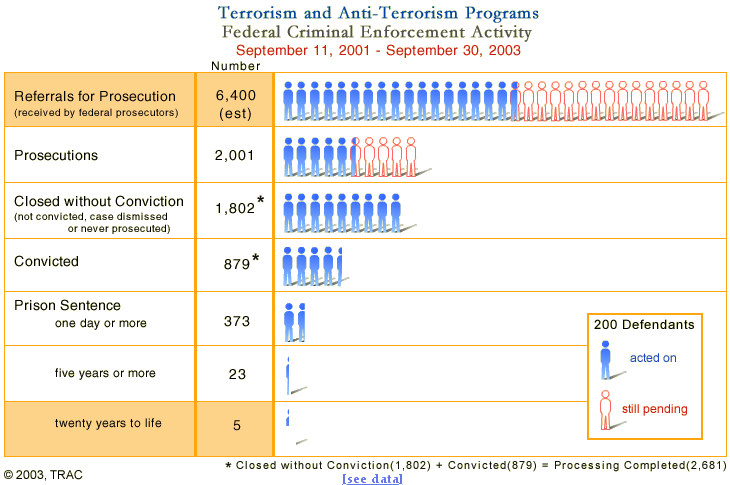
I can name 3 of the people who got 20 years:
John Walker Lindh, al-Amoudi, and Moussaoui.
Post Modified: 09/15/06 17:14:44
nada
R2154773 months ago
These statistics seem dubious though. Not the white paper doc, but TRAC’s data. For example:
International Terrorism Criminal Referrals by Federal Judicial District New Jersey. Referrals-16; Convictions-1;Median Prison Sentence-804 months From This
and this excerpt from a newspaper article dated 4/6/06:“Four teenagers accused of plotting to kill about 25 people in a lunch-period massacre at Winslow Township High School were charged today with terrorism, a crime no one has ever been convicted of in New Jersey.”Link
This article goes on to quote:
“State judiciary spokeswoman Winnie Comfort said no one in New Jersey has been convicted of terrorism, a charge lawmakers created four years ago in response to the Sept. 11 attacks. Under the statute, people convicted of the crime in adult court must be sentenced to at least 30 years in prison and are not eligible for parole for 30 years.”
These stats show an individual sentenced to 804 months or 67 years, yet the state judiciary spokeswoman clearly states that no one has been convicted. So it must have been a conviction that happened in the last 3 months of 2001 or the first 4 months of 2002.
These statistics are all dubious at this point. There is no distinction of exactly what the convictions and charges are for or if the heavy sentences reflect multiple counts or serious terrorism related convictions. In this Department of Justice document entitled: “Department of Justice Examples of Terrorism Convictions Since Sept. 11, 2001” Link
It states: “Hamant Lakhani (District of New Jersey) – British national Hemant Lakhani was convicted by a federal jury on charges of attempting to sell shoulder-fired missiles to what he thought was a terrorist group intent on shooting down U.S. airliners. Lakhani was sentenced to 47 years in prison.”
But this article states: “A BRITISH businessman was yesterday found guilty of attempting to provide material support to terrorists in the United States.
Hemant Lakhani, 69, from north London, was also convicted of illegal weapons brokering, two counts of money laundering and for importing merchandise into the US using false statements.
Lakhani turned to look at his wife, Kusum, in disbelief as the verdict was announced. He faces 25 years in jail.
The jury at New Jersey District Court in Newark returned its verdict after about eight hours.”
Attempting to provide material support.
Does that equate to a terrorism conviction?
This was not considered a terrorist conviction by TRAC’s statistics.
Sunday, December 03, 2006
"The States Don't Have sovereignty if its about drugs" Clause
Intro to the Supreme Court: I have little insight in to the current Supreme Court, after Rehnquist’s passing and O’Connor’s resignation things may change. Sometimes individuals get on the court and find they don’t HAVE to be loyal to the powers that put them there. This is what the court was looking like before these two events. The Bloc:Rehnquist led the bloc. He had two pets. One was named Antonin Scalia who was his Rottweiler. Ant would be overzealous in his assault for his owner Rehnquist in all the opinions. His other pet was named Clarence Thomas. Clarence was a lapdog he made sure that he was close to his owner Rehnquist at all times. So the chief justice had two rubber stamps that could be counted on come hell or high water. Kennedy often rolls thick with “The Bloc”.
The Swingers: O’Connor and Souter. These two will find themselves going between “The Bloc” and dissent. Ginsberg is often a swinger.
The Dissent:Breyer, Stevens, and Ginsberg. These individuals could be counted on most of the time when it came to protecting our constitutional rights. Even if it meant making sure the states do not violate them. These individuals were not as closely knit as “The Bloc” and could come down on different sides of an issue.
So this is how the Supreme Court made decisions….Rehnquist would decide and if the dissent couldn’t put together a coalition then…..............Rehnquist made the Supreme Court’s decision.
How does the judiciary work: The Supreme Court is like old Europe’s Kings. Their word is law. They do not speak it though; they write it in tightly woven opinions that use language and logic to create a justification for their decision. The justification must be according to binding precedent (stare decisis). So cases in the past with similar facts from courts in their jurisdiction must be abided by. The idea is to have the court move slowly and only have the power of making their word law in short controlled bursts. Just like all power it corrupts and just like all institutions it will become co-opted by the powerful. The check on what is referred to as “judicial tyranny” is the fact that decisions cannot be radical departures from precedent and that the “divine word” only comes in the short controlled bursts. The final check on this tyranny is that the court has no solvency mechanism/executive. They have no agent to carry out their will; instead they rely on the legislature and executive to abide by their decisions. The Supreme Court only makes decisions on constitutionality through its power of judicial review. Constitutional questions are the only jurisdiction of the Supreme Court. The constitution is “the highest law of the land”.
A short history for context: We are in the late stages of a movement which brought tremendous progress, but failed to create a lasting victory. Our era is still the “civil rights era”. The important pieces of this “highest laws of the lands” in recent times have become the “equal protection clause”, “the supremacy clause”, and the “interstate commerce clause”.The supremacy clause states that the constitution is the highest law of the land and the Supreme Court the highest court of the land. It states that federal law supersedes state law and federal courts are supreme above state courts. The “interstate commerce clause” makes it illegal for the federal government to interfere with state sovereignty unless it involves issues of interstate commerce. The framer’s intent with this was to avoid protectionist disputes by having the federal government act as mediator in issues of interstate commerce. This is the only explicit jurisdiction of the federal government as provided by the constitution regarding the issue of state sovereignty. The equal protection clause is contained in the 14th amendment to the constitution. It states that everyone should get equal protection under the law. This is the clause that allowed the 1964 civil rights act to be legislated by the federal government. It was decided that in situations where the state is not protecting the constitutional rights of the citizens the federal government can step in. During the lead up to desegregation and the 64 civil rights act the defense of tyranny lay with the “interstate commerce clause”. It was argued that if Alabama wants to segregate its’ schools and keep Jim Crow alive then that is not the jurisdiction of the federal government. Now because courts are highly politicized institutions (although many believe they are objective and noble) the court provided justification for this denial of individual’s constitutional rights. Now there is a large amount of precedent for devolution in this ongoing “federalism” debate.
If you have seen the movie ‘the rock’ you know that Sean Connery quotes Oscar Wilde: “Patriotism is the last refuge of scoundrels”. Well in this situation “federalism is the last refuge of scoundrels”. Prejudiced individuals defended “de jure” inequality under the argument that the federal government can only intervene under the “interstate commerce clause”. When individuals like grover norquist claim that they are defending federalism the truth is they are activists working for devolution. They are the individuals who would have rejected the constitution and kept the articles of confederation. These individuals call their agenda of “devolution” federalism. There are some who will call my claim radical, but the proof is in the puddin’. The court only upholds federalism when it suits the agenda of it’s’ masters.
Bush v. Gore: 1.The Opinon “On December 8, 2000, the Supreme Court of Florida ordered that the Circuit Court of Leon County tabulate by hand 9,000 ballots in Miami-Dade County…. The court further held that relief would require manual recounts in all Florida counties where so-called “undervotes” had not been subject to manual tabulation. The court ordered all manual recounts to begin at once. Governor Bush and Richard Cheney, Republican Candidates for the Presidency and Vice Presidency, filed an emergency application for a stay of this mandate. On December 9, we granted the application, treated the application as a petition for a writ of certiorari, and granted certiorari.”-The court stopped the ballot counting
“The question before the Court is not whether local entities, in the exercise of their expertise, may develop different systems for implementing elections. Instead, we are presented with a situation where a state court with the power to assure uniformity has ordered a statewide recount with minimal procedural safeguards. When a court orders a statewide remedy, there must be at least some assurance that the rudimentary requirements of equal treatment and fundamental fairness are satisfied.Given the Court’s assessment that the recount process underway was probably being conducted in an unconstitutional manner, the Court stayed the order directing the recount so it could hear this case and render an expedited decision. The contest provision, as it was mandated by the State Supreme Court, is not well calculated to sustain the confidence that all citizens must have in the outcome of elections.”-This is arguing that the ballot counting was not uniform so therefore the equal protection clause is not satisfied.
“The Supreme Court of Florida has said that the legislature intended the State’s electors to “participat[e] fully in the federal electoral process,” as provided in 3 U.S.C. § 5. _ So. 2d, at _ (slip op. at 27); see also Palm Beach Canvassing Bd. v. Harris, 2000 WL 1725434, *13 (Fla. 2000). That statute, in turn, requires that any controversy or contest that is designed to lead to a conclusive selection of electors be completed by December 12. That date is upon us, and there is no recount procedure in place under the State Supreme Court’s order that comports with minimal constitutional standards. Because it is evident that any recount seeking to meet the December 12 date will be unconstitutional for the reasons we have discussed, we reverse the judgment of the Supreme Court of Florida ordering a recount to proceed.”The Majority opinion chooses the president not out right, but de facto. With very little time left they remand the case to Florida and ask for “constitutional review” to make sure the recount abides by the equal protection clause. This is basically saying that the Supreme Court wants it out of their hands and needs to let the state handle it to have legitimacy.
2.The dissent that doesn’t try to hide its’ logic from the light of day by coating it in innocuous rhetoric m Souter “To recount these manually would be a tall order, but before this Court stayed the effort to do that the courts of Florida were ready to do their best to get that job done. There is no justification for denying the State the opportunity to try to count all disputed ballots now.”
3.The dissent that scolds the Supreme Court, Breyer “The Court was wrong to take this case. It was wrong to grant a stay. It should now vacate that stay and permit the Florida Supreme Court to decide whether the recount should resume.”
This case was decided because the Supreme Court didn’t feel it had the jurisdiction to create a “federal chad standard”. The Supreme Court did not decide who would be president “de jure”, but by not using its power of review to create a just and fair election the Supreme Court “de facto” decided who would be president. This is also important because it contributes to the mainstream understanding of the election. In many individuals’ minds this case actually LEANT LEGITIMACY to Bush’s election because they did not fully grasp the decision and facts of the case. The final decision rests on the fact that no constitutional (equal protection clause) means are available for counting ballots so there is no way to conduct a constitutional counting of votes. Thusly…..there won’t be a counting of votes. There it is “Federalism”, exploited to support their agenda.
What we should understand is this is the tip of the iceberg. If Alito gets confirmed, then he and Roberts stay loyal to their masters then we will see “The Bloc” become 5 votes, a majority. Coupled with the recent trend of expanding executive power creates a dangerous recipe. We may have an executive out of control who will obtain rubber stamps from a fully co-opted supreme court to justify police state actions (Patriot act, NSAgate, suspension of Habeas Corpus, etc).
So I didn’t prove that the court’s recent incarnation exploits “federalism” when it serves its’ masters ends. I did prove that they use “federalism” to justify things like “Bush v. Gore”. Well it’s too god damn easy to prove it’s exploited: UNITED STATES v. OAKLAND CANNABIS BUYERS’ COOPERATIVE
I guess there is another implicit clause in the constitution: The “States Don’t Have Sovereignty If It’s About Drugs” clause. There was also a case this year that the Supreme Court decided another medicinal marijuana case on the States Don’t Have Sovereignty If It’s About Drugs” clause. When assholes claim they are defending the framer’s intent of “the commerce clause” most of the time its another way of saying: I use “federalism” as a cover story for my agenda of devolution, I use federalism to justify any action that suits my masters’ agenda, or they are just straight racist and wish things were still “separate but equal”.
The Swingers: O’Connor and Souter. These two will find themselves going between “The Bloc” and dissent. Ginsberg is often a swinger.
The Dissent:Breyer, Stevens, and Ginsberg. These individuals could be counted on most of the time when it came to protecting our constitutional rights. Even if it meant making sure the states do not violate them. These individuals were not as closely knit as “The Bloc” and could come down on different sides of an issue.
So this is how the Supreme Court made decisions….Rehnquist would decide and if the dissent couldn’t put together a coalition then…..............Rehnquist made the Supreme Court’s decision.
How does the judiciary work: The Supreme Court is like old Europe’s Kings. Their word is law. They do not speak it though; they write it in tightly woven opinions that use language and logic to create a justification for their decision. The justification must be according to binding precedent (stare decisis). So cases in the past with similar facts from courts in their jurisdiction must be abided by. The idea is to have the court move slowly and only have the power of making their word law in short controlled bursts. Just like all power it corrupts and just like all institutions it will become co-opted by the powerful. The check on what is referred to as “judicial tyranny” is the fact that decisions cannot be radical departures from precedent and that the “divine word” only comes in the short controlled bursts. The final check on this tyranny is that the court has no solvency mechanism/executive. They have no agent to carry out their will; instead they rely on the legislature and executive to abide by their decisions. The Supreme Court only makes decisions on constitutionality through its power of judicial review. Constitutional questions are the only jurisdiction of the Supreme Court. The constitution is “the highest law of the land”.
A short history for context: We are in the late stages of a movement which brought tremendous progress, but failed to create a lasting victory. Our era is still the “civil rights era”. The important pieces of this “highest laws of the lands” in recent times have become the “equal protection clause”, “the supremacy clause”, and the “interstate commerce clause”.The supremacy clause states that the constitution is the highest law of the land and the Supreme Court the highest court of the land. It states that federal law supersedes state law and federal courts are supreme above state courts. The “interstate commerce clause” makes it illegal for the federal government to interfere with state sovereignty unless it involves issues of interstate commerce. The framer’s intent with this was to avoid protectionist disputes by having the federal government act as mediator in issues of interstate commerce. This is the only explicit jurisdiction of the federal government as provided by the constitution regarding the issue of state sovereignty. The equal protection clause is contained in the 14th amendment to the constitution. It states that everyone should get equal protection under the law. This is the clause that allowed the 1964 civil rights act to be legislated by the federal government. It was decided that in situations where the state is not protecting the constitutional rights of the citizens the federal government can step in. During the lead up to desegregation and the 64 civil rights act the defense of tyranny lay with the “interstate commerce clause”. It was argued that if Alabama wants to segregate its’ schools and keep Jim Crow alive then that is not the jurisdiction of the federal government. Now because courts are highly politicized institutions (although many believe they are objective and noble) the court provided justification for this denial of individual’s constitutional rights. Now there is a large amount of precedent for devolution in this ongoing “federalism” debate.
If you have seen the movie ‘the rock’ you know that Sean Connery quotes Oscar Wilde: “Patriotism is the last refuge of scoundrels”. Well in this situation “federalism is the last refuge of scoundrels”. Prejudiced individuals defended “de jure” inequality under the argument that the federal government can only intervene under the “interstate commerce clause”. When individuals like grover norquist claim that they are defending federalism the truth is they are activists working for devolution. They are the individuals who would have rejected the constitution and kept the articles of confederation. These individuals call their agenda of “devolution” federalism. There are some who will call my claim radical, but the proof is in the puddin’. The court only upholds federalism when it suits the agenda of it’s’ masters.
Bush v. Gore: 1.The Opinon “On December 8, 2000, the Supreme Court of Florida ordered that the Circuit Court of Leon County tabulate by hand 9,000 ballots in Miami-Dade County…. The court further held that relief would require manual recounts in all Florida counties where so-called “undervotes” had not been subject to manual tabulation. The court ordered all manual recounts to begin at once. Governor Bush and Richard Cheney, Republican Candidates for the Presidency and Vice Presidency, filed an emergency application for a stay of this mandate. On December 9, we granted the application, treated the application as a petition for a writ of certiorari, and granted certiorari.”-The court stopped the ballot counting
“The question before the Court is not whether local entities, in the exercise of their expertise, may develop different systems for implementing elections. Instead, we are presented with a situation where a state court with the power to assure uniformity has ordered a statewide recount with minimal procedural safeguards. When a court orders a statewide remedy, there must be at least some assurance that the rudimentary requirements of equal treatment and fundamental fairness are satisfied.Given the Court’s assessment that the recount process underway was probably being conducted in an unconstitutional manner, the Court stayed the order directing the recount so it could hear this case and render an expedited decision. The contest provision, as it was mandated by the State Supreme Court, is not well calculated to sustain the confidence that all citizens must have in the outcome of elections.”-This is arguing that the ballot counting was not uniform so therefore the equal protection clause is not satisfied.
“The Supreme Court of Florida has said that the legislature intended the State’s electors to “participat[e] fully in the federal electoral process,” as provided in 3 U.S.C. § 5. _ So. 2d, at _ (slip op. at 27); see also Palm Beach Canvassing Bd. v. Harris, 2000 WL 1725434, *13 (Fla. 2000). That statute, in turn, requires that any controversy or contest that is designed to lead to a conclusive selection of electors be completed by December 12. That date is upon us, and there is no recount procedure in place under the State Supreme Court’s order that comports with minimal constitutional standards. Because it is evident that any recount seeking to meet the December 12 date will be unconstitutional for the reasons we have discussed, we reverse the judgment of the Supreme Court of Florida ordering a recount to proceed.”The Majority opinion chooses the president not out right, but de facto. With very little time left they remand the case to Florida and ask for “constitutional review” to make sure the recount abides by the equal protection clause. This is basically saying that the Supreme Court wants it out of their hands and needs to let the state handle it to have legitimacy.
2.The dissent that doesn’t try to hide its’ logic from the light of day by coating it in innocuous rhetoric m Souter “To recount these manually would be a tall order, but before this Court stayed the effort to do that the courts of Florida were ready to do their best to get that job done. There is no justification for denying the State the opportunity to try to count all disputed ballots now.”
3.The dissent that scolds the Supreme Court, Breyer “The Court was wrong to take this case. It was wrong to grant a stay. It should now vacate that stay and permit the Florida Supreme Court to decide whether the recount should resume.”
This case was decided because the Supreme Court didn’t feel it had the jurisdiction to create a “federal chad standard”. The Supreme Court did not decide who would be president “de jure”, but by not using its power of review to create a just and fair election the Supreme Court “de facto” decided who would be president. This is also important because it contributes to the mainstream understanding of the election. In many individuals’ minds this case actually LEANT LEGITIMACY to Bush’s election because they did not fully grasp the decision and facts of the case. The final decision rests on the fact that no constitutional (equal protection clause) means are available for counting ballots so there is no way to conduct a constitutional counting of votes. Thusly…..there won’t be a counting of votes. There it is “Federalism”, exploited to support their agenda.
What we should understand is this is the tip of the iceberg. If Alito gets confirmed, then he and Roberts stay loyal to their masters then we will see “The Bloc” become 5 votes, a majority. Coupled with the recent trend of expanding executive power creates a dangerous recipe. We may have an executive out of control who will obtain rubber stamps from a fully co-opted supreme court to justify police state actions (Patriot act, NSAgate, suspension of Habeas Corpus, etc).
So I didn’t prove that the court’s recent incarnation exploits “federalism” when it serves its’ masters ends. I did prove that they use “federalism” to justify things like “Bush v. Gore”. Well it’s too god damn easy to prove it’s exploited: UNITED STATES v. OAKLAND CANNABIS BUYERS’ COOPERATIVE
I guess there is another implicit clause in the constitution: The “States Don’t Have Sovereignty If It’s About Drugs” clause. There was also a case this year that the Supreme Court decided another medicinal marijuana case on the States Don’t Have Sovereignty If It’s About Drugs” clause. When assholes claim they are defending the framer’s intent of “the commerce clause” most of the time its another way of saying: I use “federalism” as a cover story for my agenda of devolution, I use federalism to justify any action that suits my masters’ agenda, or they are just straight racist and wish things were still “separate but equal”.
Subscribe to:
Posts (Atom)